Chemistry and Specifications
Methane chemistry, NGLs, heating value units, the Wobbe Index, pipeline-quality specs, odorization, LNG feed gas requirements, and custody-transfer measurement.
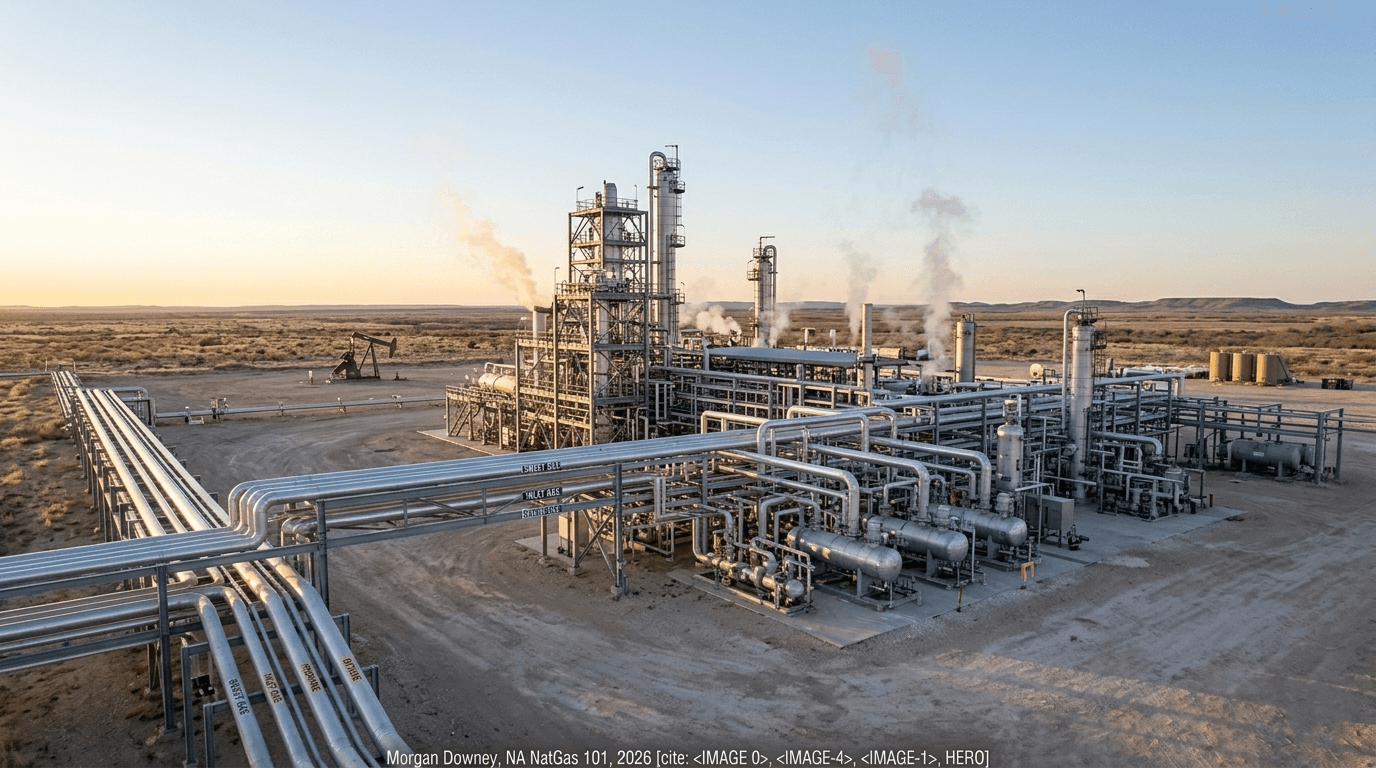
The Cove Point regasification terminal sits on the Maryland shore of the Chesapeake Bay, about 60 miles southeast of Washington. It was built by Columbia LNG in the 1970s as one of the original four US LNG import terminals, mothballed in 1980 when the domestic gas glut killed the case for imports, sold to Williams, and reopened by Dominion Energy in 2003 to receive cargoes from Atlantic LNG, the four-train liquefaction complex on the southwest coast of Trinidad. The molecules looked nothing like Henry Hub gas.
Trinidad gas was rich. Atlantic LNG produced cargoes with heating values around 1,090 to 1,150 Btu per standard cubic foot, well above the 1,000 to 1,030 Btu typical of dry US pipeline gas at the time. The interchangeability ratio, captured by a metric called the Wobbe Index, was high enough that residential and commercial burners tuned for Henry Hub gas would burn hotter and produce more nitrogen oxide than they were designed for. Industrial boilers risked excursions on permitted NOx limits. Distribution utilities that had spent decades tuning their delivered gas to a stable composition would have to re-tune burner orifices across millions of customer appliances.
The response was a multi-year regulatory and operational effort. The Federal Energy Regulatory Commission opened a docket on gas quality in 2005. The North American Energy Standards Board published a technical white paper that February that every subsequent pipeline tariff would draw on. Several US LNG import terminals installed nitrogen blending equipment to dilute high-Wobbe regas streams. Pipelines tightened their interchangeability tariff language. The wave of rich LNG receipts from Trinidad, Egypt, and Algeria turned out to be smaller than the industry feared; by 2010 the shale revolution had reversed the import-export polarity of the US gas system.
The infrastructure built to handle rich foreign LNG was repurposed less than a decade after it was installed.
The Methane Molecule
Methane is one carbon and four hydrogens, arranged in a tetrahedron with the carbon at the center and the hydrogens at the vertices. The bond angles are 109.5 degrees, the geometry of any sp3-hybridized carbon. The molecule is non-polar, has no permanent dipole, and at standard temperature and pressure exists as a gas with a density of about 0.66 kilograms per cubic meter, less than half the density of air. A methane leak rises and ventilates. A propane or butane leak settles at the floor.
The carbon-to-hydrogen ratio is 1 to 4, the lowest of any hydrocarbon. Combustion in air with sufficient oxygen produces carbon dioxide and water vapor and nothing else: one methane plus two oxygens yields one carbon dioxide and two waters. The lower heating value of methane is about 50 megajoules per kilogram, slightly higher than gasoline on a per-mass basis. The higher heating value, which captures the latent heat released as the water vapor product condenses, is closer to 55 megajoules per kilogram. On a per-volume basis methane is much less energy-dense than gasoline, because it is a gas at ambient conditions. A standard cubic foot of pipeline methane carries about 1,030 Btu; a gallon of gasoline carries about 115,000.
Methane is hard to ignite. The autoignition temperature is around 537 degrees Celsius, well above gasoline’s roughly 280 degrees. The flammability range in air is 5 to 15 percent by volume, narrower than most light hydrocarbons. The flame speed at stoichiometric ratio is around 0.4 meters per second, slower than gasoline vapor. The slow flame speed and the narrow flammability range are why combined cycle gas turbines have to manage flame stability with care, why methane is generally less explosively dangerous than propane or butane on a per-mass basis, and why the natural gas industry has historically run with a smaller catastrophic-incident rate than the LPG industry. The combustion stoichiometry is also why methane has the lowest carbon dioxide intensity of any hydrocarbon fuel: roughly 53 kilograms of CO2 per gigajoule, against 70 for gasoline, 73 for diesel, and around 95 for coal.
What Else Is in Raw Wellhead Gas
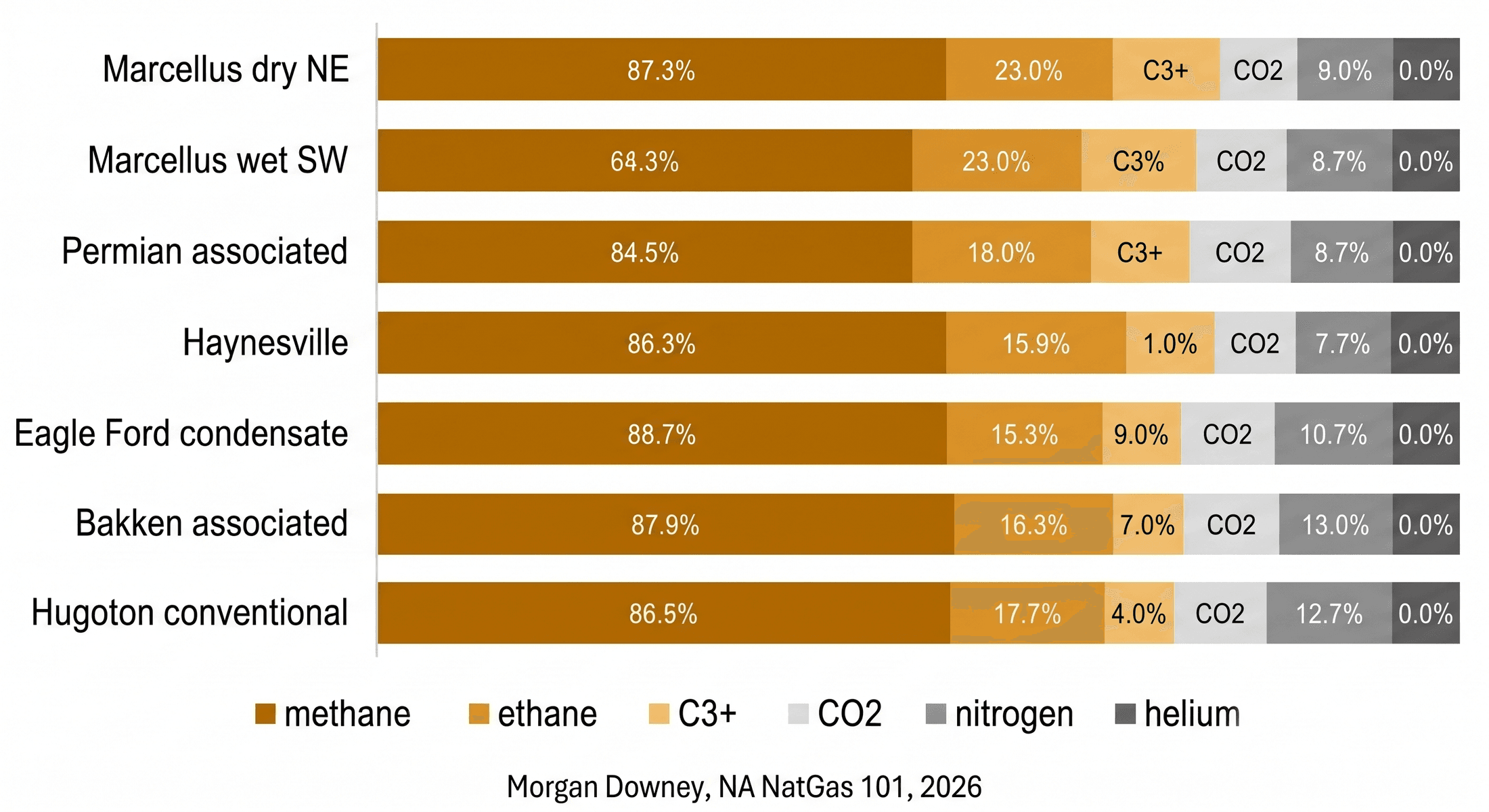
Pure methane never leaves a wellhead. Every gas stream produced from a hydrocarbon reservoir is a mixture, and the composition varies with the maturity of the source rock, the depth and temperature of the reservoir, and the geological history of the basin.
The largest cohort of constituents is the light alkanes. Ethane, propane, normal butane, isobutane, and a fraction labeled pentanes-plus or C5+ that captures pentane, hexane, heptane, and heavier hydrocarbons through the natural gasoline range. The industry calls these the natural gas liquids, NGLs, even though only the heavier members are liquid at ambient pressure. They are recovered at processing plants downstream of the wellhead and sold separately as their own commodities. Their share of the wellhead stream is set by basin maturity. Dry gas wells produce streams that are 95 percent methane or higher with single-digit-percent NGL content. Wet gas wells from the oil-window edge of the same basin can deliver streams that are 65 to 80 percent methane with the rest distributed across ethane, propane, and the heavier alkanes.
Inert components dilute the heating value of the stream without contributing to combustion. Nitrogen is the most common inert. It enters the reservoir from formation water, from the atmosphere during burial, or from biogenic decay. Most US pipeline gas runs 0.5 to 2 percent nitrogen. Some Hugoton gas runs above 10 percent and requires nitrogen rejection at the processing plant before the gas can be sold into the interstate pipeline grid. Carbon dioxide is also an inert from a combustion standpoint, but it is corrosive when wet and forms carbonic acid that attacks pipeline steel. CO2 at the wellhead ranges from less than 0.5 percent in clean dry shale gas to several percent in some deeper Permian streams and a small set of Rocky Mountain fields. Helium is present in trace amounts in most gas streams, and reaches commercially significant concentrations in only a handful of North American fields. The Hugoton Field in southwestern Kansas, the Oklahoma Panhandle, and the Texas Panhandle has helium contents ranging from 0.3 to 1.9 mol percent and supports the only commercial helium extraction operation in the US Lower 48. The Riley Ridge field in southwestern Wyoming feeds a separate extraction plant operated by ExxonMobil at LaBarge. Outside these two basins, helium is too dilute to justify the cost of cryogenic separation.
Acid components are the third category. Hydrogen sulfide makes a gas stream sour. H2S is acutely toxic at low concentrations: levels above 100 ppmv are immediately dangerous to life and health, and a single breath above 700 ppmv can be fatal. Most US interstate pipelines reject gas above 4 ppmv H2S, though specifications vary. Some basins are nearly sweet. The Marcellus and Utica shales produce gas with H2S below the detection threshold of standard chromatography. The deeper Permian Wolfcamp, parts of the Smackover, and certain Williston Basin streams produce gas with H2S concentrations that require amine sweetening before the molecule reaches the pipeline. Carbonyl sulfide and the lighter mercaptans are present in smaller amounts and stripped at the same processing step. Mercaptans are also added back deliberately downstream of the city gate as odorants, a topic taken up later in this chapter.
Trace contaminants matter disproportionately because cryogenic processing equipment cannot tolerate them. Mercury is present at sub-ppb levels in most North American gas, but reaches concentrations in the 1 to 100 microgram per normal cubic meter range in some basins, including parts of the Bakken and certain offshore Gulf of Mexico fields. Mercury attacks aluminum cryogenic exchangers, the heart of any LNG liquefaction train, by amalgamating with the metal at grain boundaries and embrittling it. Mercury removal beds, typically sulfur-impregnated activated carbon, are standard at any processing plant feeding an LNG facility. Water vapor must be removed before any gas reaches an interstate pipeline, because at line pressure and ambient temperature it forms hydrates: ice-like solid plugs that block flow. Oxygen is rare in produced gas because the reservoir is anaerobic, and its presence at more than trace levels signals an air leak in the gathering or processing system. Particulates, mostly formation sand and pipe scale, are filtered before the gas leaves the gathering line.
| Basin | Methane | Ethane | C3+ | CO2 | N2 | He |
|---|---|---|---|---|---|---|
| Marcellus dry NE | 96-98% | 1-2% | <1% | <0.5% | 0.5-1.5% | trace |
| Marcellus wet SW | 80-90% | 6-12% | 4-8% | <1% | 0.5-1.5% | trace |
| Permian associated | 70-85% | 8-15% | 5-15% | 1-3% | 0.5-2% | trace |
| Haynesville | 95-98% | <2% | <1% | <0.5% | 0.5-1% | trace |
| Eagle Ford condensate | 65-80% | 8-15% | 7-20% | <2% | 0.5-2% | trace |
| Bakken associated | 55-70% | 10-15% | 10-20% | 1-3% | 1-3% | trace |
| Hugoton conventional | 70-85% | 5-8% | 2-5% | 1-3% | 5-15% | 0.3-1.9% |
Heating Value: Btu, Mcf, MMBtu, Therm, Dekatherm
A British thermal unit, abbreviated Btu, is the energy required to raise the temperature of one pound of water by one degree Fahrenheit at sea-level pressure. It is the unit the US gas industry uses to measure energy content. One Btu equals roughly 1,055 joules.
A standard cubic foot, abbreviated scf, is a fixed quantity of gas defined at a reference temperature and pressure. The reference conditions are not universal. Most US interstate pipelines use 60 degrees Fahrenheit and 14.73 pounds per square inch absolute, a convention adopted by the American Gas Association in the early 20th century. Some pipelines use 14.696 psia, the standard atmospheric pressure at sea level. Some Canadian operations and most European applications use 15 degrees Celsius and 101.325 kPa. The differences are small but they compound over high-volume transactions and they appear explicitly in any custody-transfer contract.
Heating value is measured in Btu per standard cubic foot. There are two conventions. Higher heating value, also called gross heating value, includes the heat of condensation of the water vapor produced during combustion. Lower heating value, also called net heating value, excludes the condensation heat on the assumption that the water leaves as a vapor. The difference for methane is about 9 to 10 percent. The United States has historically used HHV; some European primary-energy statistics use LHV, though European pipeline tariffs typically also use HHV.
Mcf is a volume measure. One Mcf equals 1,000 scf. The "M" is the Roman numeral for thousand, not the SI prefix mega. MMcf, "million cubic feet," equals 1,000 Mcf. Bcf, "billion cubic feet," equals 1,000 MMcf. These units describe how much gas was metered through a pipe.
MMBtu is an energy measure. One MMBtu equals one million Btu. A dekatherm, abbreviated Dth, equals ten therms, where one therm is 100,000 Btu. One Dth therefore equals one MMBtu. The dekatherm survives in regulated utility tariffs because it was the legacy unit when state utility commissions wrote rate schedules in the mid-20th century.
The Mcf-versus-MMBtu distinction matters when gas composition varies. A pipeline that meters 1,000 cubic feet of dry Henry Hub gas at 1,030 Btu/scf delivers 1.03 MMBtu of energy. The same pipeline metering 1,000 cubic feet of wet Eagle Ford gas at 1,250 Btu/scf delivers 1.25 MMBtu, 21 percent more energy at the same volumetric flow. Contracts written on Mcf basis assume a fixed heating value and short-change the seller when the gas is wet. Contracts written on MMBtu basis pay for energy delivered. The Henry Hub futures contract on the CME Group settles in MMBtu, and modern producer-to-pipeline contracts almost universally do as well. Older contracts, particularly some pre-shale residential and commercial supply agreements, are still written in Mcf or therms with assumed conversion factors that may not reflect the actual composition of the delivered molecule.
Utility bills typically report consumption in therms or in Ccf, where one Ccf equals 100 cubic feet. Ten Ccf make one Mcf, so a bill showing 80 Ccf is 8 Mcf. The conversion to therms runs through the therm factor, sometimes called the Btu factor, which the utility posts on the bill and revises as the quality of the delivered gas changes. It is the heating value restated as therms per Ccf rather than Btu per cubic foot, so gas at 1,030 Btu/scf carries a therm factor of 1.03, and those same 80 Ccf bill as 82.4 therms. The factor typically sits between 1.02 and 1.04. Every gas bill carries the translation tables in fine print.
The Wobbe Index
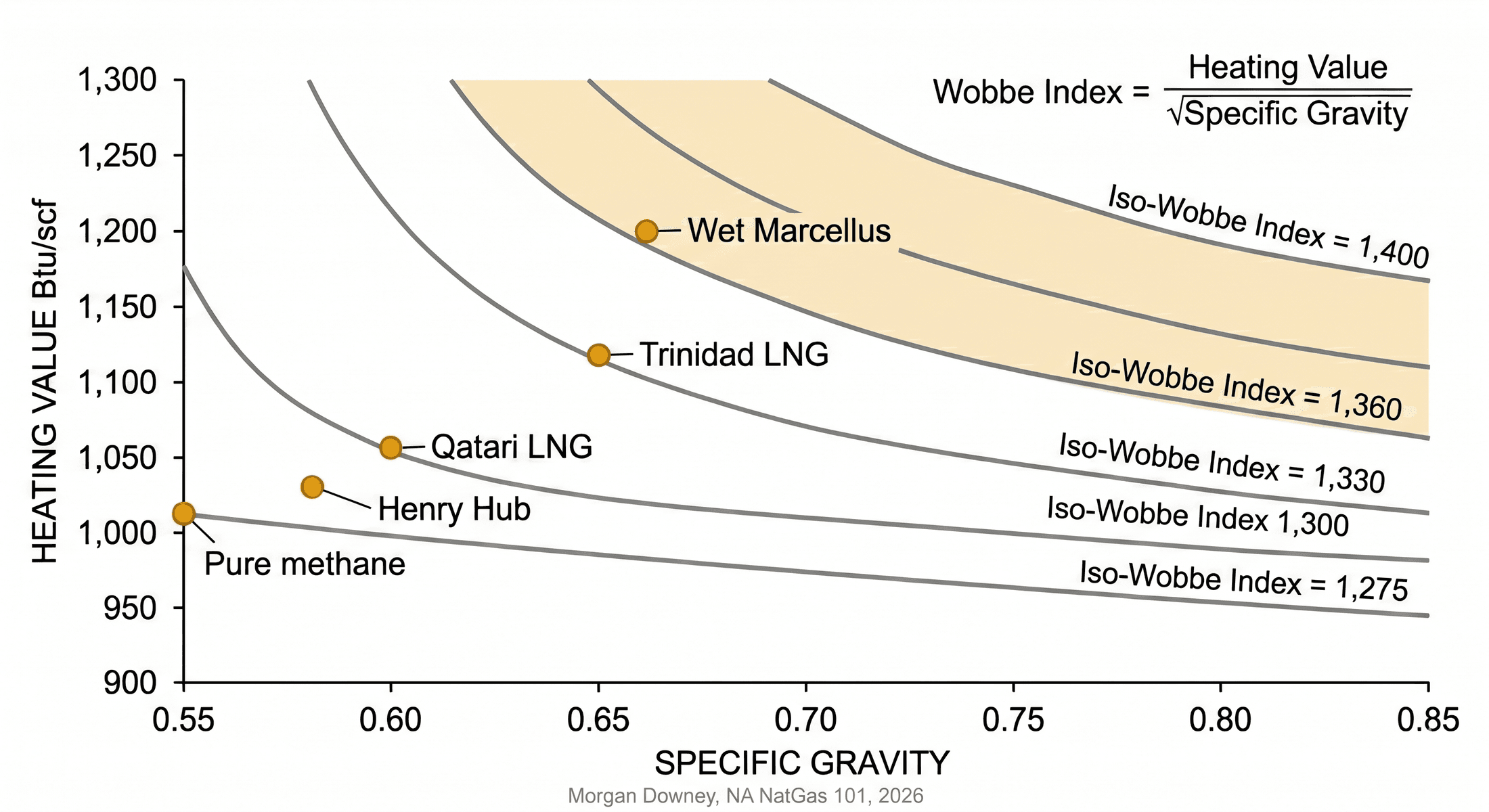
The Wobbe Index is the interchangeability metric. It tells a burner designer whether two gas streams of different composition will produce the same heat release through a fixed orifice. The definition is the higher heating value divided by the square root of specific gravity, where specific gravity is the ratio of gas density to air density at the same conditions. Wobbe carries units of energy per volume, the same as heating value, but the square root of specific gravity in the denominator captures how flow rate through a fixed orifice changes with gas density. A heavier gas flows more slowly through the same hole. The Wobbe normalization holds delivered heat release constant as long as the index is constant, even when the underlying heating value and the specific gravity move in opposite directions.
A burner tuned for a specific Wobbe Index will produce the same heat output, the same flame shape, and the same combustion chemistry across any gas stream with that same Wobbe, even when the heating value and specific gravity differ. Pipelines and downstream end-users care about Wobbe rather than raw Btu/scf because the appliance fleet has already been tuned to a particular range, and changing the gas means changing the appliance.
US pipeline gas Wobbe Indexes typically run 1,300 to 1,400 Btu/scf, with most large interstate systems clustering around 1,330 to 1,360. The Algonquin Gas Transmission tariff has historically allowed roughly 1,275 to 1,400 Btu/scf. The European Union’s harmonized standard EN 16726 specifies a Wobbe range expressed in metric units that converts to roughly 1,300 to 1,510 Btu/scf for cross-border transmission, with member states free to maintain tighter national specs.
What happens when high-Wobbe gas reaches a low-Wobbe-tuned burner is mechanical. Heat release increases. Flame temperature rises. Excess oxygen falls because more fuel is being delivered to the same air supply. Carbon monoxide, soot, and nitrogen oxides all increase. Industrial boilers exceed permitted NOx limits. Residential furnaces yellow-tip, sooting the heat exchanger and risking carbon monoxide spillage into the home. Combined cycle gas turbines, which run lean and depend on tight composition control, can flame-out or trip on flame-detection alarms.
The Trinidad LNG arrival described in the cold open was the most public Wobbe interchangeability event the US gas system has had to manage. Cove Point, Lake Charles, Elba Island, and the Distrigas terminal at Everett either built or maintained nitrogen ballasting capacity to dilute incoming high-Wobbe streams. The investment was made largely redundant by 2010 as US shale gas displaced LNG imports. The infrastructure remains. Some of the same nitrogen rejection units now run in reverse during specific operational events when leaner gas needs to be enriched.
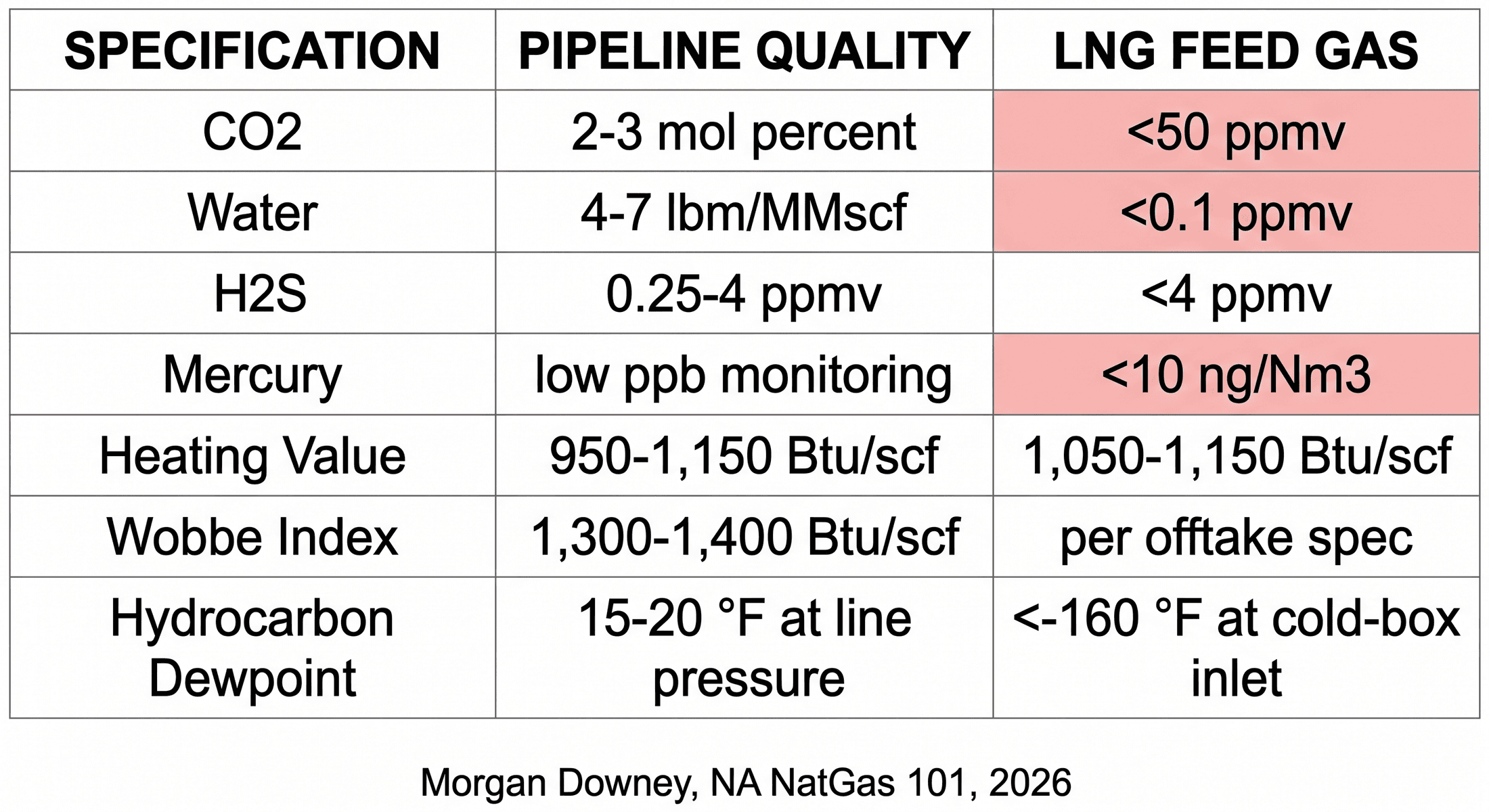
Pipeline-Quality Gas Specifications
A US interstate gas pipeline is a regulated common carrier under the Natural Gas Act of 1938. It accepts gas from upstream shippers and delivers it to downstream customers under a published Federal Energy Regulatory Commission tariff. The tariff is the binding contract; the gas-quality section is one of its most important provisions. Every interstate pipeline has its own. There is no single "US pipeline-quality gas" specification. There is a band of common ranges and a set of standards bodies, GPA Midstream, the American Gas Association, the American Petroleum Institute, that publish technical references the tariffs cite. The numbers below are representative; any specific delivery is governed by the tariff of the pipeline carrying it.
Heat content. Most US interstate pipelines accept gas in a 950 to 1,150 Btu/scf range. Tennessee Gas Pipeline’s FERC tariff has historically set the range at roughly 967 to 1,110 Btu/scf. The Transco system, Williams’ interstate corridor from the Gulf Coast to New York, runs roughly 950 to 1,100. Off-spec gas above the upper bound is typically blended with nitrogen or with leaner gas at the receipt point until it falls within range. Off-spec gas below the lower bound is rejected.
Water content. Typical maximum is 4 to 7 pounds of water per million standard cubic feet. At line pressures of 800 to 1,200 psig, water content above this level forms hydrates or condenses as liquid water, both of which interfere with flow. Some pipelines run 4 lbm/MMscf in winter when ambient temperatures can drive the hydrate dew point lower.
Hydrocarbon dewpoint. Typical limit is 15 to 20 degrees Fahrenheit at line pressure. Above this, heavier hydrocarbons condense in the pipeline and pool at low spots. Pipelines moving wet gas often impose tighter dewpoint specs near liquid-handling facilities and looser specs in the deeper pipeline core.
Carbon dioxide. Typical maximum is 2 to 3 mol percent. CO2 above this level is corrosive to carbon-steel pipe in the presence of water and reduces heating value below specification. Most pipeline tariffs run 2 mol percent. Producers running gas with above-spec CO2 must process it through an amine plant before tendering to the pipeline.
Total sulfur. Typical maximum runs from a fraction of a grain to several grains per 100 standard cubic feet, where one grain equals 64.8 milligrams. The range varies because total sulfur captures H2S, carbonyl sulfide, mercaptans, and organic sulfur compounds in aggregate, and tariffs treat the components differently. Many tariffs separate H2S (commonly 0.25 grains per 100 scf, equivalent to roughly 4 ppmv) from total sulfur (commonly 1 to 5 grains per 100 scf).
Hydrogen sulfide. Typical maximum is 0.25 to 4 ppmv across most US interstate pipelines, with 4 ppmv (roughly 0.25 grains per 100 scf) the most common figure. Some Gulf Coast pipelines accepting sour gas tolerate higher concentrations under specific tariff provisions. H2S above spec must be removed by amine sweetening before the gas reaches the pipeline.
Oxygen. Typical maximum is 0.2 to 1 mol percent, with most modern pipelines specifying 0.2 percent or lower. Oxygen at higher concentrations promotes corrosion in the presence of moisture and creates flammability concerns at storage caverns and at compressor stations.
Mercury. Typical limit for pipelines feeding cryogenic processing or LNG facilities is in the low parts-per-billion range. Pipelines without downstream cryogenic exposure may not impose a mercury spec at all and rely on a monitoring program instead.
Other limits cover delivery temperature (typically 40 to 120 degrees Fahrenheit), delivery pressure (typically 600 to 1,200 psig depending on pipeline), particulate filtration, and the absence of detectable odorant in transmission-grade gas. Odorant is added downstream of the city gate, not at the wellhead, because adding mercaptan upstream would contaminate the entire pipeline with sulfur compounds far above any total-sulfur specification.
Numbers in this chapter are common ranges. The pipeline’s tariff is the binding document for any specific delivery.
Greene County, Pennsylvania, 2010
In 2010, as the Marcellus shale moved from pilot wells into mass production, the gas that flowed into the Texas Eastern, Tennessee, Columbia Gulf, and Transco systems from the southwest Pennsylvania wet-gas core regularly tested at heating values of 1,150 to 1,250 Btu per standard cubic foot. The legacy gas-purchase contracts the midstream operators had on the books had been written in Mcf, often with assumed conversion factors based on the 1,030 Btu Henry Hub gas the systems had transported for decades. A producer delivering one million cubic feet per day of 1,250 Btu Marcellus gas was tendering 1,250 MMBtu of energy and being paid for the equivalent of 1,030. The 20 percent gap was not trivial.
Producers pushed back. Several of the largest Marcellus operators sued for renegotiation or moved to MMBtu-based contracts at the next renewal cycle. By the early 2010s, virtually every producer-to-pipeline gas-sales contract in the Appalachian Basin was written on MMBtu, with the gas chromatograph at the receipt point determining the energy delivered. The Mcf survives as a volume measure. It stopped being a payment unit. The chromatograph won.
Odorization
Pipeline-grade natural gas is odorless. Methane, ethane, and the inert components have no smell at the concentrations a human nose can register. A leak in a residential or commercial gas line is invisible until the concentration reaches the lower flammability limit, at which point the next ignition source produces an explosion.
The historical anchor is the New London, Texas school explosion on Thu March 18, 1937. The London Independent School District in Rusk County had tapped into an unodorized casinghead gas line operated by a nearby gasoline plant to provide free heating to a consolidated school. A leak accumulated in the school’s basement crawlspace during the school day. At about 3:17 PM a shop teacher activated an electric sander, the spark ignited the gas, and the explosion destroyed most of the building. Roughly 295 students and teachers were killed. The Texas Legislature passed an odorization mandate within weeks. Federal regulation followed. Today, US Department of Transportation regulations under 49 CFR 192.625 require that natural gas in any distribution line and in transmission lines passing through populated areas be odorized so that any concentration in air above one-fifth of the lower explosive limit is detectable by a person with a normal sense of smell.
The odorant is a blend of mercaptans, typically ethyl mercaptan, tertiary butyl mercaptan, and dimethyl sulfide, mixed for a sharp persistent smell that does not fade in transit and that does not foul downstream metering equipment. Industrial and large commercial customers receiving high-pressure gas directly from transmission lines often receive unodorized gas, both because mercaptans interfere with some industrial processes and because the regulatory requirement attaches to distribution and to transmission through populated areas rather than to large industrial supply.
Specifications for LNG Feed Gas and Petrochemical Feedstock
Liquefaction trains operate at minus 162 degrees Celsius, the boiling point of methane at atmospheric pressure. Any contaminant that freezes above that temperature, dissolves into the cryogenic liquid, or attacks the cryogenic equipment must be removed before the feed gas enters the cold box. The specifications are therefore much tighter than pipeline-quality.
Carbon dioxide. The pipeline limit of 2 to 3 mol percent is far above what an LNG train can tolerate. CO2 freezes at minus 78.5 degrees Celsius, well above LNG operating temperature, and solid CO2 in the cold-box heat exchangers blocks flow channels, fouls turbine blades, and produces unplanned shutdowns. LNG feed gas specifications typically require CO2 below 50 ppmv. The amine plant on the front end of any liquefaction train is sized to remove pipeline-quality CO2 down to this level.
Water. Pipeline-quality water content of 4 to 7 lbm per MMscf is far above the LNG limit. Water freezes at zero Celsius, far above cold-box operating temperature, and ice plugs the same heat-exchanger channels that solid CO2 fouls. LNG feed gas typically runs 0.1 ppmv water or below, achieved by molecular sieve dehydrator beds that adsorb water vapor down to the parts-per-billion level.
Mercury. As described earlier, mercury attacks aluminum cryogenic exchangers by amalgamation. LNG feed gas specifications typically require mercury below 10 nanograms per normal cubic meter, several orders of magnitude tighter than any pipeline-quality limit. Mercury removal beds, usually sulfur-impregnated activated carbon, sit between the dehydrator and the cold box and run for years before saturation.
Heavy hydrocarbons. Pentanes and heavier, particularly aromatics like benzene and toluene, freeze at temperatures above the LNG operating range. The benzene freezing point is 5.5 degrees Celsius. LNG feed gas specifications typically limit benzene to less than 1 ppmv and total aromatics to less than 10 ppmv. The pre-cooling and scrub-column stages of the liquefaction train remove the bulk of the heavy hydrocarbons as a separate liquid stream that is sold as natural gasoline or recycled into the LNG depending on heating-value targets.
The acceptable Btu/scf range in most LNG offtake contracts is wider than the typical pipeline range. Cargoes commonly run 1,050 to 1,150 Btu/scf with a target near 1,100. Buyer-imposed Wobbe Index limits in some contracts cap the rich end of the range to align with downstream pipeline interchangeability. Cargoes that fall outside a buyer’s specification are diverted to a different buyer or blended with leaner gas at a regas terminal.
Petrochemical feedstock specifications differ in priority. An ethane cracker buying ethane recovered at a Mont Belvieu fractionator wants high purity. A typical contract specification calls for at least 95 percent ethane with ethylene below 0.5 percent, propane below 3 percent, and total inerts below 0.5 percent. A propane dehydrogenation unit producing propylene wants HD-5 propane: greater than 90 percent propane, less than 5 percent propylene, and less than 2.5 percent C4-and-heavier impurities. A methanol or urea unit running on natural gas wants pipeline-quality gas with tight sulfur control because the synthesis catalysts are sensitive to sulfur and to chlorides at the parts-per-billion level. The chemistry of the reactor sets the tightness of the spec, not the pipeline.
Custody Transfer and Online Analysis
Every Btu of gas that changes hands at a custody-transfer point is metered. The flow meter, typically an orifice meter, an ultrasonic meter, or a Coriolis meter, measures volumetric flow. A gas chromatograph at the same point measures composition. Multiplying the volume by the heating value calculated from the composition gives the energy delivered, the number on which the contract pays.
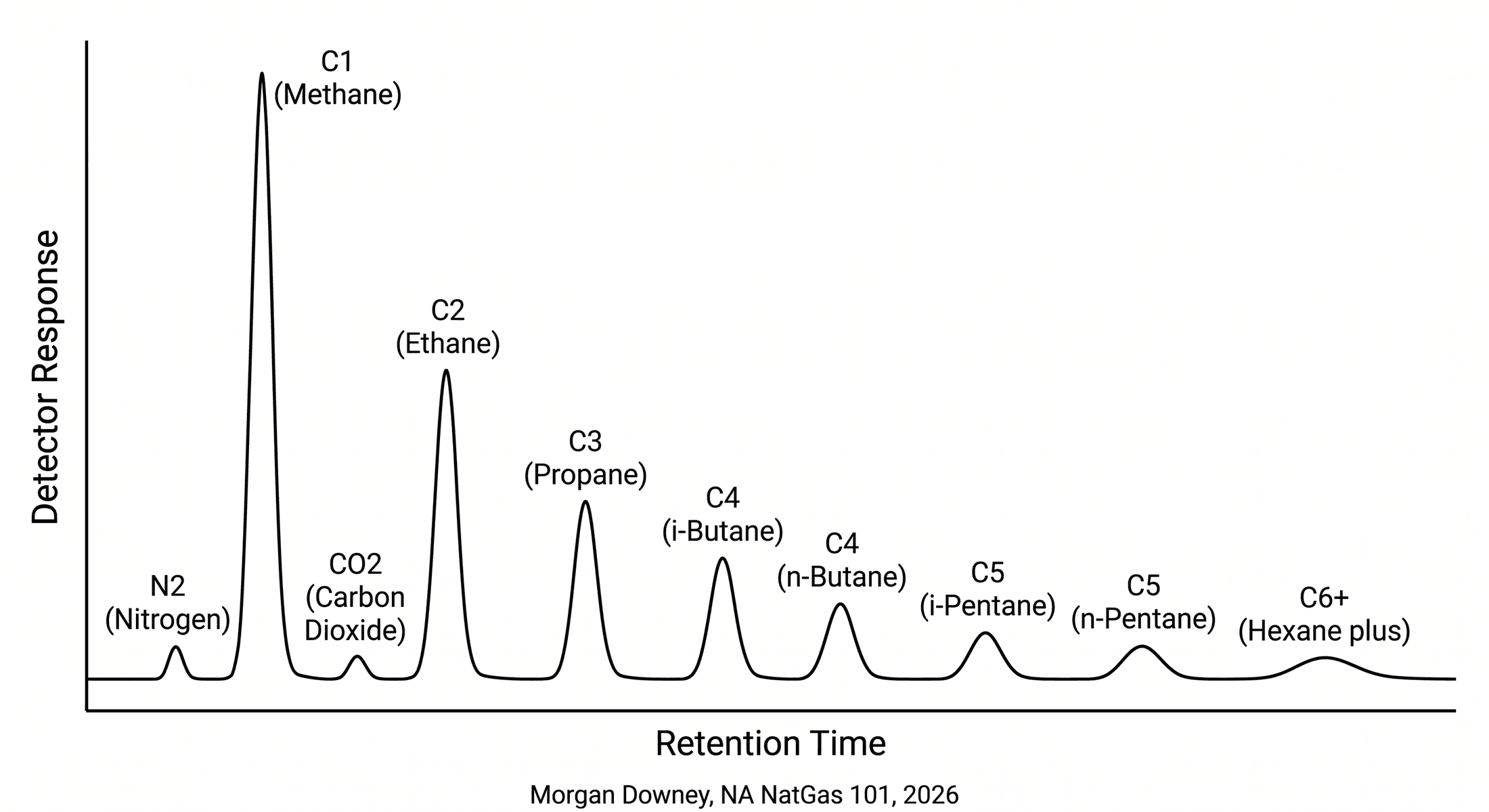
The chromatograph is the instrument of record. A typical online GC at a gas-processing plant outlet or at a pipeline interconnect samples the stream every two to ten minutes, separates the components into individual peaks on a packed or capillary column, and reports back C1 through C6+ along with nitrogen, carbon dioxide, hydrogen sulfide, and oxygen. Calibration is against a certified reference gas mixture traceable to the National Institute of Standards and Technology. The calculation of heating value, specific gravity, and Wobbe Index from the composition follows AGA Report No. 5, the American Gas Association’s standard for determining heating value. The conversion of measured volumetric flow to a base-condition standard cubic foot follows AGA Report No. 8 for the equation of state in custody-transfer applications. Outside the United States, ISO 6976 covers the heating-value calculation from composition.
API Manual of Petroleum Measurement Standards Chapter 14, Section 5, abbreviated API 14.5, covers the calculation of gross heating value and other gas properties from a chromatographic analysis. The standard sets out the sample-handling, integration, and rounding conventions used in the US. Pipelines and producers reference API 14.5 in their tariffs and contracts.
The economic stake is small per cubic foot and large per facility. A 1 Bcf/d pipeline interconnect moving gas at 1,030 Btu/scf delivers about 1.03 trillion Btu per day, or roughly 1,030,000 dekatherms. A 0.5 percent error in the chromatograph’s heating value calculation moves the daily settlement by more than $20,000 at $4 per MMBtu and by more than $50,000 in a tight winter market. A 2 percent error breaks careers. Custody-transfer instruments are calibrated weekly, audited monthly, and re-certified annually under contractual obligations that survive any change in operator or counterparty.
Specifications determine which molecules are accepted into the pipeline grid and which are rejected at the wellhead. Chapter 6 turns from the molecule to the activity that produces it: exploration and drilling.